Restoring of the DNA of the Bride

Blocked Fallopian Tubes

Condition:

Blocked Fallopian Tubes

Definition:

Blocked Fallopian Tubes

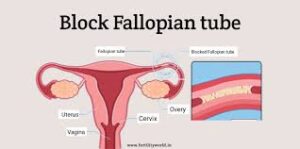
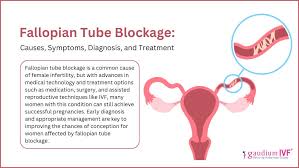
A hydrosalpinx is fluid blockage in your fallopian tubes that may make it difficult for you to become pregnant. Damage to your fallopian tubes, most often from an untreated infection, can cause a hydrosalpinx. Treatments include draining and repairing the tubes or removing them (salpingectomy). Many individuals and couples who want to have a baby opt for IVF after treating a hydrosalpinx.

Another name for blocked fallopian tubes is hydrosalpinxHydrosalpinx specifically refers to a condition where the fallopian tube is blocked and filled with fluid, often due to damage from infection. In medical terms, a blocked fallopian tube is also referred to as tubal occlusion. 
Elaboration:
  • Hydrosalpinx:

    This term describes a fluid-filled and blocked fallopian tube, typically caused by infection or damage. 

  • Tubal Occlusion:

    This is a general term for any blockage in the fallopian tube, regardless of the cause. 
  • Blocked Fallopian Tube:
    This is a common and straightforward way to describe the condition, though it lacks the specific details of hydrosalpinx. 

Symptom:

Blocked Fallopian Tubes

Symptoms and Causes

What are the signs and symptoms of a hydrosalpinx?

A hydrosalpinx rarely causes symptoms. You may not realize your tubes are blocked until your provider investigates what’s making it difficult for you to become pregnant.

When symptoms are present, they include:

  • Pelvic pain that may worsen during or immediately following your period.
  • Vaginal discharge that’s discolored and/or sticky.

What causes a hydrosalpinx?

An untreated infection is the most common cause of a hydrosalpinx. Harmful bacteria can damage your fallopian tubes and cause them to become inflamed. This inflammation often happens at the part of your fallopian tube near your ovaries, or your fimbriae. Your fimbriae are finger-like extensions that sweep an egg from your ovaries into your fallopian tubes.

As part of the healing process, your fimbriae may fuse together, sealing your fallopian tubes. Fluid gets trapped inside your tubes, causing them to swell.

Hydrosalpinx causes include:
  • Previous untreated sexually transmitted infections (STIs), like chlamydia and gonorrhea.
  • Pelvic inflammatory disease (PID), oftentimes resulting from untreated STIs.
  • Scar tissue left over from pelvic surgery, especially surgery on your fallopian tubes.
  • Tissue build-up from endometriosis.
  • Some tumors.


Description:

Blocked Fallopian Tubes

A hydrosalpinx is fluid blockage in your fallopian tubes that may make it difficult for you to become pregnant. Damage to your fallopian tubes, most often from an untreated infection, can cause a hydrosalpinx. Treatments include draining and repairing the tubes or removing them (salpingectomy). Many individuals and couples who want to have a baby opt for IVF after treating a hydrosalpinx.

Another name for blocked fallopian tubes is hydrosalpinxHydrosalpinx specifically refers to a condition where the fallopian tube is blocked and filled with fluid, often due to damage from infection. In medical terms, a blocked fallopian tube is also referred to as tubal occlusion. 

Elaboration:
  • Hydrosalpinx:

    This term describes a fluid-filled and blocked fallopian tube, typically caused by infection or damage. 

  • Tubal Occlusion:

    This is a general term for any blockage in the fallopian tube, regardless of the cause. 
  • Blocked Fallopian Tube:
    This is a common and straightforward way to describe the condition, though it lacks the specific details of hydrosalpinx.

Overview

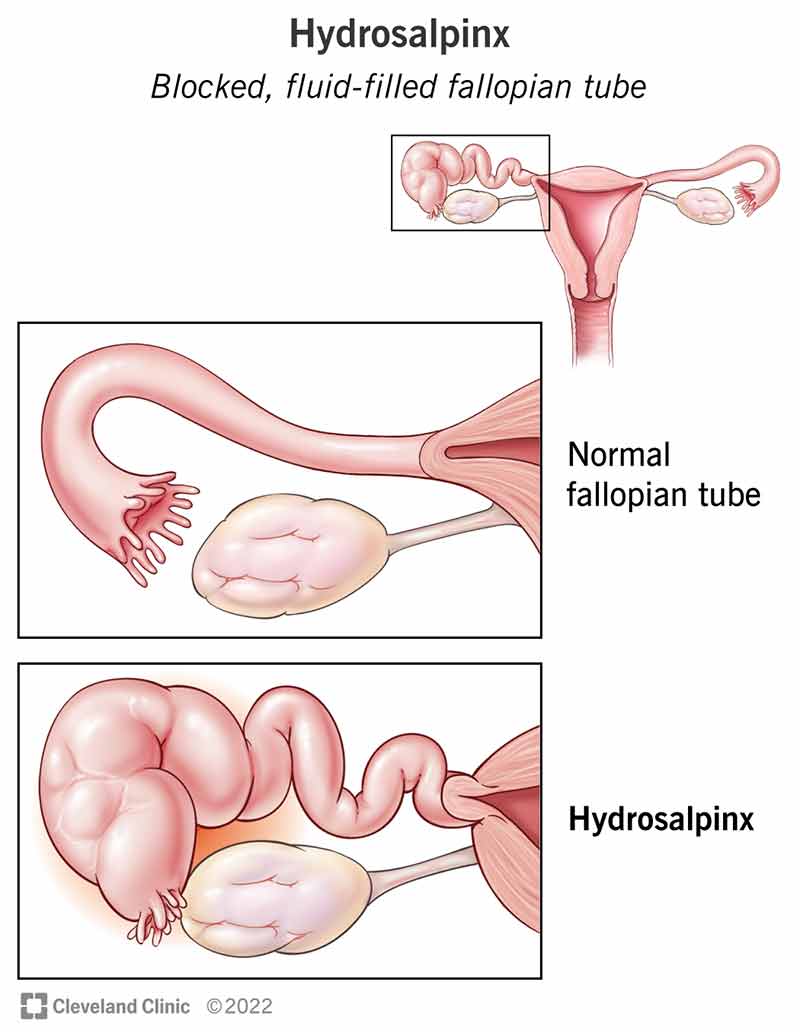
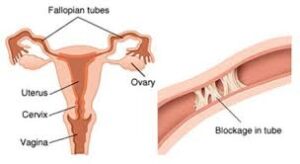
Comparison of a normal, open fallopian tube and a blocked tube with hydrosalpinx
With a hydrosalpinx, fluid build-up blocks one or both fallopian tubes.

What is hydrosalpinx?

Hydrosalpinx is a condition where fluid accumulates in one or both fallopian tubes, creating a blockage. Your fallopian tubes extend from your uterus to your ovaries. Each month, as part of your menstrual cycle, your ovaries produce an egg that moves through your fallopian tubes. Healthy fallopian tubes provide an open passageway for an egg and a sperm to unite (fertilization). The fertilized egg, or embryo, travels the same open passageway to your uterus. From there, an embryo can implant in your uterine wall and develop into a fetus.

With a hydrosalpinx, fluid build-up blocks this passageway. A blocked fallopian tube may prevent sperm from reaching your egg. If fertilization does occur, the blockage in your fallopian tube can prevent the embryo from reaching your uterus.

How common is hydrosalpinx?

Twenty to 30% of infertility cases involve problems related to the fallopian tubes (tubal factor infertility). Hydrosalpinx is present in 10% to 20% of these cases.

How does hydrosalpinx affect my body?

An untreated hydrosalpinx can make it difficult to become pregnant, and it can increase your risk of miscarriage and pregnancy complications. In addition to making it difficult to get pregnant through intercourse, a hydrosalpinx can:

  • Increase your risk of an ectopic (tubal) pregnancy: An embryo that’s unable to reach your uterus because of a blockage may implant in your fallopian tubes, resulting in an ectopic pregnancy. These pregnancies aren’t viable and can be life-threatening without treatment.
  • Decrease your chances of becoming pregnant through in vitro fertilization (IVF): IVF can help you get pregnant without your fallopian tubes. With IVF, your provider collects your eggs and fertilizes them outside your body using sperm from your partner or a donor. Then, your provider transfers the embryo into your uterus, where it can develop. A hydrosalpinx can cause problems once the embryo implants into your uterine wall. Research suggests that the fluid from a hydrosalpinx can flow backwards into your uterus, creating an unhealthy environment for a developing embryo.

Treating a hydrosalpinx increases your chances of a healthy pregnancy, even if you opt for IVF.
Protocol:

Blocked Fallopian Tubes

1 Capsule Hormone Balance Blend daily

2 Capsules Hormone Balance Herbal Capsules twice daily

2 Capsule DNA Protector Blend twice daily

Ovary Support Adult Roll-on over the ovaries topical twice a day

1 Pipet full of the Frankincense and Myrrh Blend 30ml  100ml

Lie flat on your back when performing this process to ensure the oil gets absorbed properly. It is best to do this just before bed at night. Lying down will reduce leakage of the blend from your vagina that could occur while standing or walking around. Absorption by the vaginal vessels, flow into the body’s circulatory system, which distributes to the body’s organs and bodily systems. Not to be used during the menstrual cycle.


Precautions & Side Effects:

Blocked Fallopian Tubes

Diagnosis and Tests

What tests will be done to diagnose a blocked fallopian tube?

Tests to check your fallopian tubes for a blockage include:

  • Ultrasound: Your fallopian tubes aren’t usually visible on an ultrasound. But if they’re swollen because of fluid build-up, they’ll appear larger than usual. Sometimes, they’ll be shaped like sausage. Your provider can order additional tests to confirm that what’s causing the change is a hydrosalpinx.
  • Hysterosalpingogram (HSG): An HSG is an X-ray dye test to check for blockages in your fallopian tubes. It’s the most common test used to diagnose hydrosalpinx. Your provider will insert a dye medium into your uterus and watch its movement via X-ray. If the dye spills out of your tubes and into your pelvic cavity, your tubes are open. If the dye stops, your tubes are blocked.
  • Laparoscopy: Laparoscopy is a minimally invasive surgery that allows your provider to see inside your abdominal cavity. They make tiny cuts into your belly and insert a small camera (laparoscope) inside to take a closer look at your fallopian tubes. Sometimes, they’ll insert a catheter into your vagina and cervix to pump dye into your uterus and fallopian tubes to check for blockages. Laparoscopy can be used to confirm the results of an HSG.

Management and Treatment

How is hydrosalpinx treated?

Treating a hydrosalpinx can improve your chances of becoming pregnant. Your treatment will depend on factors like the severity of your blockage and your age.

If you have an active infection, your provider will prescribe antibiotics to resolve it. Surgical treatments include:

  • Salpingectomy: Removes one or both fallopian tubes (bilateral salpingectomy).
  • Salpingostomy (neo salpingostomy): Repairs the blockage in your tubes. Salpingostomy is usually performed using laparoscopy. With salpingostomy, your provider makes a small incision into your fallopian tube to drain it. Your provider can remove the damaged parts of the tube and reopen the ends that have sealed shut. The outcomes associated with salpingostomy have made it a less popular option than IVF in recent years. Your risk of a miscarriage and pregnancy complications may increase following this surgery. IVF has a better success rate for pregnancies than salpingostomy.

Many individuals and couples who are trying to have a baby receive treatment for the hydrosalpinx and then opt for IVF, bypassing the fallopian tubes altogether. Your provider can advise you on the best options depending on your unique case.

How do you get rid of hydrosalpinx naturally?

There aren’t natural remedies for hydrosalpinx. If there’s only a small amount of damage to your tubes, your provider may be able to repair them with a salpingostomy. For a more severe hydrosalpinx, you may need to have one or both fallopian tubes removed.

Prevention

How can I reduce my risk of a hydrosalpinx?

Reducing your risk of getting an STI is the best way to avoid a hydrosalpinx. Practicing safer sex can decrease the odds of an infection that that may harm your reproductive organs.

Outlook / Prognosis

What happens if hydrosalpinx is left untreated?

An untreated hydrosalpinx decreases your odds of becoming pregnant and increases your risk of miscarriage and complications like ectopic pregnancy. Receiving treatment greatly improves your chance of a healthy pregnancy.

Is hydrosalpinx life-threatening?

Hydrosalpinx on its own isn’t life-threatening, but it can increase your risk of ectopic pregnancy, which can be life-threatening without treatment.

Recommended Products:

DNA PROTECTOR BLEND 100 ML
R1,500.00 Incl. VAT
DNA PROTECTOR BLEND 30ML
R500.00 Incl. VAT
HORMONE BALANCE BLEND 100 ML
R1,200.00 Incl. VAT
HORMONE BALANCE BLEND 30ML
R420.00 Incl. VAT
HORMONE BALANCE HERBAL CAPSULES 120
R440.00 Incl. VAT
OVARY SUPPORT ADULT ROLL-ON 10ML
R250.00 Incl. VAT

Complimentory Products:

December Deals Are Here!

Visit our Shop page and click on the December Sale filter to view over 400 products on special

For Distributors: Combine your wholesale discount with our December special for even bigger savings!