
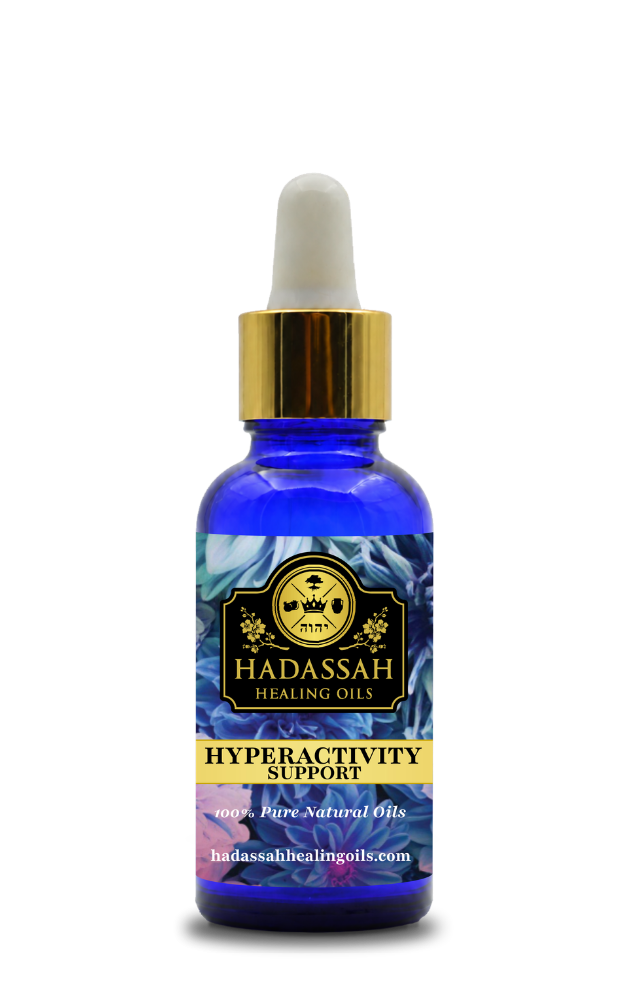
HYPERACTIVITY BLEND 30ML
R400.00 Incl. VAT
HYPERACTIVITY BLEND 30ML
Support children and adults experiencing patterns of excessive physical restlessness, heightened arousal, difficulty settling, sensory overstimulation, emotional reactivity and difficulty transitioning into rest and sleep.
- 3-5 working days
- All products include VAT.
- Client Testimonies
- 100% Natural
- 100% Pure Essential Oils
- 100% Manufacturing Guarantee
- Share to social media
Description
Directions for Use
Warning
Ingredients
Technical Information
HYPERACTIVITY BLEND 30ML
Hyperactivity Support is a specialised neuroregulatory botanical formulation developed to support children and adults experiencing patterns of excessive physical restlessness, heightened arousal, difficulty settling, sensory overstimulation, emotional reactivity and difficulty transitioning into rest and sleep.
Rather than functioning through one pathway, the formulation combines volatile phytochemicals with activity relevant to several areas of central nervous-system physiology:
GABAergic inhibitory signalling
Glutamatergic/NMDA excitatory signalling
Serotonergic signalling
Neuronal membrane excitability
Autonomic nervous-system regulation
Stress-response pathways
Sleep and arousal regulation
The pharmacological objective is not simply sedation.
It is to support the neurological balance between excitation and inhibition—helping an overstimulated nervous system move toward a more regulated physiological state.
Regulate excessive arousal.
Support inhibitory signalling.
Reduce neurological overstimulation.
Support emotional regulation.
Create the physiological conditions for calmer attention and restorative sleep.
HYPERACTIVITY BLEND 30ML
DIRECTIONS FOR TOPICAL USE
Apply a small amount to appropriate intact skin and massage gently.
Suitable areas include:
Underneath Feet
Upper back , neck and chest
Shoulders and inhalation
For evening use, apply before the child’s normal bedtime routine.
For daytime support, use conservatively before periods where calm attention and behavioural regulation are needed.
HYPERACTIVITY BLEND 30ML
Avoid the face, eyes, mouth, nose, mucous membranes and broken skin.
Wash adult hands after applying the product to a child.
Patch test before first use.
HYPERACTIVITY BLEND 30ML
Lavender
Mandarin/Tangerine
Roman Chamomile
Frankincense
Sweet Orange
Vetiver
Sandalwood
Bergamot
Cedarwood
Valerian and Olive Oil.
Advanced Botanical Neuroregulation
Hyperactivity Support has been designed around neurochemical regulation rather than simple sedation.
Linalool and Linalyl Acetate from Lavender influence excitatory glutamatergic/NMDA signalling, serotonin transport and neuronal ion-channel activity.
Valerian-derived Valerenic Acid provides a complementary inhibitory mechanism through allosteric modulation of GABA-A receptors.
Roman Chamomile adds ester-rich neuromuscular regulation.
Vetiver, Cedarwood and Sandalwood provide a dense sesquiterpene neuroregulatory fraction.
Bergamot, Mandarin and Sweet Orange contribute limonene-rich chemistry supporting autonomic and stress-response regulation.
Frankincense completes the formula with a terpene-rich neurological and inflammatory-support component.
HYPERACTIVITY BLEND 30ML
Hyperactivity Support is a specialised neuroregulatory botanical formulation developed to support children and adults experiencing patterns of excessive physical restlessness, heightened arousal, difficulty settling, sensory overstimulation, emotional reactivity and difficulty transitioning into rest and sleep.
The formulation combines:
Lavender • Mandarin/Tangerine • Roman Chamomile • Frankincense • Sweet Orange • Vetiver • Sandalwood • Bergamot • Cedarwood • Valerian • Olive Oil
Rather than functioning through one pathway, the formulation combines volatile phytochemicals with activity relevant to several areas of central nervous-system physiology:
GABAergic inhibitory signalling
Glutamatergic/NMDA excitatory signalling
Serotonergic signalling
Neuronal membrane excitability
Autonomic nervous-system regulation
Stress-response pathways
Sleep and arousal regulation
The pharmacological objective is not simply sedation.
It is to support the neurological balance between excitation and inhibition—helping an overstimulated nervous system move toward a more regulated physiological state.
UNDERSTANDING HYPERACTIVITY
Hyperactivity is not simply “too much energy.”
In conditions such as ADHD, the neurobiology is considerably more complex and can involve altered regulation within networks responsible for:
Attention
Impulse control
Executive function
Working memory
Motivation
Behavioural inhibition
Emotional regulation
Catecholamine signalling—particularly dopamine and noradrenaline within prefrontal cortical networks—is important in ADHD.
But behavioural hyperarousal is also influenced by the broader balance between excitatory and inhibitory neurotransmission.
Two important neurotransmitter systems are:
GLUTAMATE
The brain’s principal excitatory neurotransmitter.
GABA
The principal inhibitory neurotransmitter.
An effective calming formulation should therefore not be described simply as “making a child sleepy.”
The pharmacological concept is reducing excessive neuronal arousal while supporting a calmer state in which attention, emotional control and sleep can function more effectively.
LAVENDER
Linalool & Linalyl Acetate — CNS Excitability and Glutamate Regulation
Lavender forms the principal component of Hyperactivity Support.
Its major pharmacologically active volatile constituents are:
LINALOOL
LINALYL ACETATE
These compounds have been extensively investigated in central nervous-system pharmacology.
Lavender and linalool interact with several neuronal targets relevant to hyperarousal.
Experimental research demonstrates activity involving:
NMDA/glutamate signalling
Serotonin transporter — SERT
Voltage-dependent calcium channels
Voltage-dependent sodium channels
Neuronal excitability
Lavender essential oil and its principal constituents have demonstrated affinity for the NMDA glutamate receptor complex.
Linalool has also demonstrated inhibition of glutamate-related signalling.
Because glutamate is the brain’s principal excitatory neurotransmitter, modulation of excessive glutamatergic activity provides a plausible mechanism through which Lavender can reduce neuronal hyperexcitability. (PubMed)
Linalool can additionally influence voltage-dependent sodium channels, while Lavender oil has demonstrated effects on calcium influx through voltage-dependent calcium channels.
These channels participate directly in neuronal firing and neurotransmitter release.
Lavender and linalool have also demonstrated interaction with the serotonin transporter, SERT, providing an additional serotonergic mechanism relevant to emotional regulation and anxiety. (PubMed)
PRINCIPAL ACTIVE COMPONENTS
Linalool • Linalyl Acetate
PRIMARY PHARMACOLOGICAL RELEVANCE
Glutamatergic/NMDA modulation • Neuronal excitability regulation • SERT interaction • Calcium-channel modulation • CNS calming
VALERIAN
Valerenic Acid & GABA-A Receptor Modulation
Valerian provides one of the most specific inhibitory-neurotransmitter mechanisms represented in the formula.
The medicinal plant Valeriana officinalis contains compounds including:
VALERENIC ACID
VALERENOL
ACETOXYVALERENIC ACID
Valerenic acid has been demonstrated to act as an allosteric modulator of GABA-A receptors.
GABA-A receptors are chloride channels.
When GABA activates these receptors, chloride conductance contributes to neuronal hyperpolarisation, making neurons less likely to fire excessively.
Experimental research demonstrated that valerenic acid potentiated GABA-A receptor currents, particularly receptors containing β2 or β3 subunits. (PubMed)
Further research demonstrated that valerenic acid and valerenol act through GABA-A receptors containing the β3 subunit, providing a defined molecular mechanism for their anxiolytic activity in experimental models. (PubMed)
The pathway can therefore be represented as:
Valerenic acid → GABA-A receptor modulation → increased inhibitory signalling → reduced neuronal excitability
PRINCIPAL ACTIVE COMPONENTS
Valerenic Acid • Valerenol and related sesquiterpenic constituents
PRIMARY PHARMACOLOGICAL RELEVANCE
GABA-A modulation • Inhibitory neurotransmission • Hyperarousal reduction • Sleep physiology • Anxiolytic mechanisms
Valerian therefore provides an important inhibitory counterbalance within the formulation.
ROMAN CHAMOMILE
Ester-Rich Neuro-Muscular Regulation
Roman Chamomile — Chamaemelum nobile — contains a distinctive ester-rich volatile fraction.
Its chemistry commonly includes various angelate esters, with exact composition depending upon source.
These compounds contribute to Roman Chamomile’s pharmacological profile involving:
Smooth-muscle relaxation
Antispasmodic activity
Inflammatory regulation
Central calming effects
Roman Chamomile complements Lavender and Valerian by supporting reduction of both physical tension and neurological hyperarousal.
PRINCIPAL ACTIVE FRACTION
Angelate-rich volatile esters
PRIMARY PHARMACOLOGICAL RELEVANCE
Neuromuscular relaxation • Antispasmodic activity • Nervous-system calming • Physical restlessness support
VETIVER
Sesquiterpene-Rich Nervous-System Support
Vetiver — Chrysopogon zizanioides — is chemically very different from citrus or Lavender oils.
Its essential oil contains a dense sesquiterpene and sesquiterpene-alcohol fraction that can include compounds such as:
Khusimol
Vetiverol-related compounds
Vetivones
Khusimene and related sesquiterpenes
Its heavier sesquiterpene chemistry gives Vetiver a distinct pharmacological profile.
Experimental research has investigated Vetiver essential oil for effects on central nervous-system activity, alertness, behaviour and neurological function.
Within Hyperactivity Support, Vetiver is positioned as part of the attention-state and nervous-system-regulation complex.
PRINCIPAL ACTIVE FRACTION
Khusimol • Vetivones • Sesquiterpene alcohols and related sesquiterpenes
PRIMARY PHARMACOLOGICAL RELEVANCE
CNS regulation • Behavioural-state support • Neurophysiological stabilisation
CEDARWOOD
Sesquiterpene-Rich Neuroregulatory Component
Cedarwood provides another sesquiterpene-dominant component.
Its chemistry depends greatly on which botanical species is used.
For example, Cedrus atlantica commonly contains compounds from the himachalene family, while other materials marketed as Cedarwood can have very different chemistry.
Potential major constituents include:
β-Himachalene
α-Himachalene
γ-Himachalene
Atlantones
depending upon species and origin.
These sesquiterpenes give Cedarwood a fundamentally different chemical profile from the monoterpene-rich citrus oils.
Within Hyperactivity Support, Cedarwood provides a slower, heavier volatile fraction intended to complement Lavender, Vetiver, Valerian and Sandalwood within the formula’s CNS-regulatory architecture.
PRINCIPAL ACTIVE FRACTION
Himachalenes and related sesquiterpenes — species dependent
PRIMARY PHARMACOLOGICAL RELEVANCE
Neuroregulatory support • Stress-response modulation • Behavioural-state support
BERGAMOT
Limonene, Linalool & Linalyl Acetate
Bergamot contains a pharmacologically useful combination of:
LIMONENE
LINALYL ACETATE
LINALOOL
with other monoterpenes depending upon extraction.
This gives Bergamot both citrus-terpene and Lavender-like neuroactive chemistry.
Human and experimental research has investigated Bergamot in relation to stress physiology, anxiety, autonomic activity and mood.
Its linalool/linalyl acetate fraction complements Lavender’s effects on neuronal signalling, while limonene provides additional neurobiological and inflammatory activity.
PRINCIPAL ACTIVE COMPONENTS
Limonene • Linalyl Acetate • Linalool
PRIMARY PHARMACOLOGICAL RELEVANCE
Stress-response regulation • Autonomic modulation • CNS support • Emotional regulation
MANDARIN / TANGERINE
Limonene-Rich Regulation
Mandarin/Tangerine essential oil is generally dominated by:
D-LIMONENE
with smaller quantities of compounds such as:
γ-Terpinene
α-Pinene
β-Pinene
Myrcene
depending upon species and source.
Limonene has been investigated experimentally for neuroactive, antioxidant and inflammatory effects.
Within this formula Mandarin primarily supports the stress-arousal and emotional-regulation component, complementing the stronger CNS-active Lavender, Valerian and Vetiver fractions.
PRINCIPAL ACTIVE COMPONENT
D-Limonene
PRIMARY PHARMACOLOGICAL RELEVANCE
Stress-response support • Neurophysiological modulation • Antioxidant support
SWEET ORANGE
D-Limonene & Autonomic Stress Response
Sweet Orange also provides a predominantly:
D-LIMONENE
volatile fraction.
Citrus-oil research has investigated effects on anxiety, stress responses and autonomic nervous-system activity.
Sweet Orange therefore strengthens the formula’s stress-arousal regulation rather than serving as a direct sedative.
This distinction is important.
A child who is restless because of physiological hyperarousal does not necessarily need to be heavily sedated.
The objective is to support movement from an excessively activated state toward a more regulated state.
SANDALWOOD
α-Santalol & β-Santalol
Sandalwood provides two particularly important sesquiterpene alcohols:
α-SANTALOL
β-SANTALOL
These compounds have been investigated for effects involving central nervous-system activity, inflammatory signalling and cellular physiology.
Sandalwood therefore adds another sesquiterpene-rich component to the Cedarwood–Vetiver–Sandalwood axis of the formula.
PRINCIPAL ACTIVE COMPONENTS
α-Santalol • β-Santalol
PRIMARY PHARMACOLOGICAL RELEVANCE
Neurophysiological regulation • CNS calming • Inflammatory modulation
FRANKINCENSE
α-Pinene & Terpene-Mediated Neurological Support
Frankincense essential oil contains a species-dependent mixture of volatile terpenes.
These can include:
α-Pinene
α-Thujene
Limonene
Sabinene
β-Caryophyllene and other terpenes
depending upon Boswellia species and origin.
α-Pinene has been investigated experimentally for neuroprotective, inflammatory and neurotransmitter-related effects.
Frankincense therefore contributes to the formula’s neurological and inflammatory-support architecture.
PRINCIPAL ACTIVE FRACTION
α-Pinene and related Boswellia volatile terpenes
PRIMARY PHARMACOLOGICAL RELEVANCE
Neuroprotective support • Inflammatory regulation • CNS support
THE NEUROPHARMACOLOGICAL STRATEGY
Hyperactivity Support can be understood through four interconnected systems.
1. EXCITATORY NEUROTRANSMISSION
LAVENDER — LINALOOL & LINALYL ACETATE
supports regulation of glutamatergic/NMDA signalling and neuronal ion-channel activity. (PubMed)
This addresses one side of neuronal excitability:
EXCESSIVE EXCITATORY SIGNALLING
2. INHIBITORY NEUROTRANSMISSION
VALERIAN — VALERENIC ACID
acts as an allosteric modulator of specific GABA-A receptors, enhancing inhibitory neuronal signalling in experimental systems. (PubMed)
This addresses the opposite side:
INSUFFICIENT INHIBITORY CONTROL / EXCESSIVE AROUSAL
Together, Lavender and Valerian therefore provide a particularly logical neurochemical pairing:
GLUTAMATE ↓ / MODULATION
GABA ↑ / POTENTIATION
=
REDUCED NEURONAL HYPEREXCITABILITY
This is a pharmacological concept rather than simply an aromatherapy description.
3. STRESS & AUTONOMIC REGULATION
Lavender
Bergamot
Mandarin
Sweet Orange
Roman Chamomile
provide overlapping phytochemistry relevant to stress, autonomic arousal and emotional regulation.
This is particularly useful where hyperactive behaviour becomes worse during:
Anxiety
Sensory overload
Emotional stress
Transitions
Fatigue
Overstimulation
4. CNS & BEHAVIOURAL-STATE SUPPORT
Vetiver
Cedarwood
Sandalwood
Frankincense
provide a sesquiterpene-rich component complementing the more volatile linalool- and limonene-rich oils.
The formula therefore combines:
MONOTERPENE CNS ACTIVITY
with
SESQUITERPENE NEUROREGULATORY SUPPORT
rather than depending upon one chemical family.
HOW HYPERACTIVITY SUPPORT MAY SUPPORT THE CHILD
The intended physiological objective is to support:
Reduced excessive arousal
Improved ability to settle
Reduced physical restlessness
Better transition from activity into quiet tasks
Emotional regulation
Reduced sensory overstimulation
Calmer bedtime transition
Sleep preparation
A more regulated state in which attention is easier to sustain
The distinction is important:
CALMING IS NOT THE SAME AS SEDATING.
The objective during the day is not to make the child sleepy.
It is to reduce unnecessary neurological and physiological “noise” so that the brain can function from a more regulated state.
DAYTIME SUPPORT
During the day, Hyperactivity Support can be incorporated before situations requiring greater regulation, such as:
School preparation
Homework
Quiet learning
Long journeys
Transitions between activities
Periods of overstimulation
The objective is a calmer but functional neurological state.
EVENING & SLEEP SUPPORT
The formulation also contains a strong sleep-transition component.
Lavender and Valerian are particularly relevant here.
Valerenic acid’s interaction with GABA-A receptors provides a defined molecular rationale for its role in reducing CNS arousal. (PubMed)
Lavender contributes complementary effects on glutamatergic, serotonergic and neuronal ion-channel systems. (DOI)
Together with Roman Chamomile, Vetiver, Cedarwood and Sandalwood, this provides a multi-pathway approach to helping the nervous system transition from:
HIGH AROUSAL → REGULATION → REST → SLEEP
DIRECTIONS FOR TOPICAL USE
Apply a small amount to appropriate intact skin and massage gently.
Suitable areas include:
underneath Feet • Upper back , neck and chest • Shoulders and inhalation
For evening use, apply before the child’s normal bedtime routine.
For daytime support, use conservatively before periods where calm attention and behavioural regulation are needed.
Avoid the face, eyes, mouth, nose, mucous membranes and broken skin.
Wash adult hands after applying the product to a child.
Patch test before first use.
PRIMARY PHARMACOLOGICAL TARGETS
GABA-A signalling
Glutamatergic/NMDA signalling
Serotonergic signalling
Voltage-dependent ion channels
Neuronal excitability
Autonomic stress regulation
Sleep-arousal physiology
KEY BIOACTIVE COMPOUNDS
Linalool / Linalyl Acetate — Lavender
Valerenic Acid / Valerenol-related chemistry — Valerian preparations
Angelate esters — Roman Chamomile
Khusimol / Vetivones / Sesquiterpenes — Vetiver
Himachalenes — Cedarwood, species dependent
α-Santalol / β-Santalol — Sandalwood
Limonene / Linalool / Linalyl Acetate — Bergamot
D-Limonene — Mandarin/Tangerine and Sweet Orange
α-Pinene and related terpenes — Frankincense
INGREDIENTS
Lavender, Mandarin/Tangerine, Roman Chamomile, Frankincense, Sweet Orange, Vetiver, Sandalwood, Bergamot, Cedarwood, Valerian and Olive Oil.
HYPERACTIVITY SUPPORT
Advanced Botanical Neuroregulation
Hyperactivity Support has been designed around neurochemical regulation rather than simple sedation.
Linalool and Linalyl Acetate from Lavender influence excitatory glutamatergic/NMDA signalling, serotonin transport and neuronal ion-channel activity.
Valerian-derived Valerenic Acid provides a complementary inhibitory mechanism through allosteric modulation of GABA-A receptors.
Roman Chamomile adds ester-rich neuromuscular regulation.
Vetiver, Cedarwood and Sandalwood provide a dense sesquiterpene neuroregulatory fraction.
Bergamot, Mandarin and Sweet Orange contribute limonene-rich chemistry supporting autonomic and stress-response regulation.
Frankincense completes the formula with a terpene-rich neurological and inflammatory-support component.
The resulting strategy is:
EXCESSIVE NEURONAL AROUSAL
↓
GLUTAMATE / NMDA MODULATION
Lavender — Linalool & Linalyl Acetate
+
INHIBITORY GABA-A SUPPORT
Valerian — Valerenic Acid
+
AUTONOMIC & STRESS REGULATION
Bergamot • Mandarin • Orange • Chamomile
+
CNS-REGULATORY SESQUITERPENES
Vetiver • Cedarwood • Sandalwood • Frankincense
↓
CALMER NEUROLOGICAL STATE
↓
BETTER SETTLING • EMOTIONAL REGULATION • REST • SLEEP SUPPORT
HYPERACTIVITY SUPPORT
Regulate excessive arousal.
Support inhibitory signalling.
Reduce neurological overstimulation.
Support emotional regulation.
Create the physiological conditions for calmer attention and restorative sleep.


