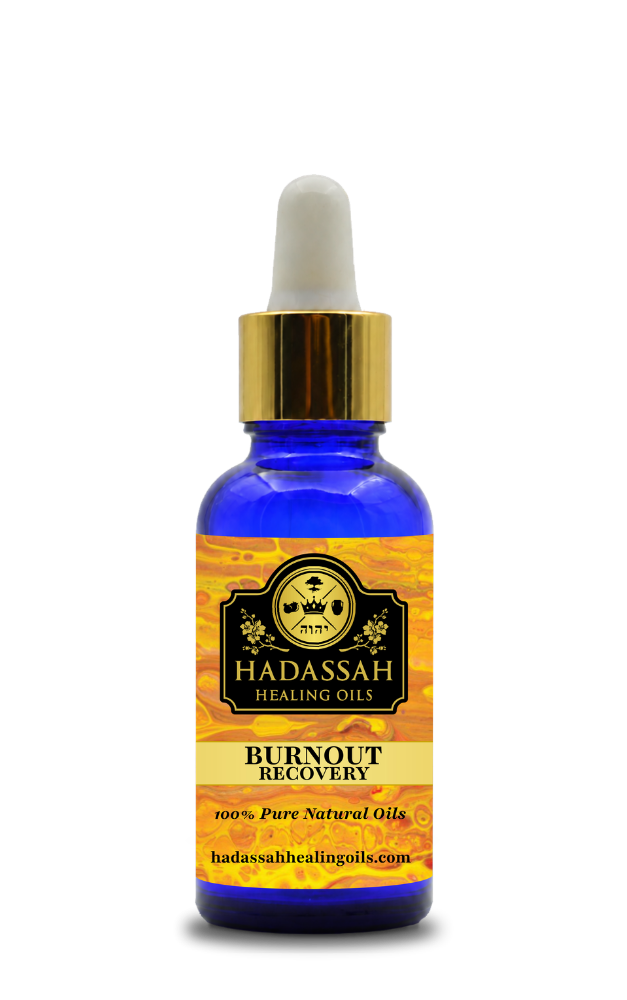
BURNOUT RECOVERY BLEND 30ML
R420.00 Incl. VAT
BURNOUT RECOVERY BLEND 30ML
Support for the exhausted body, overloaded nervous system and prolonged physiological stress response.
- 3-5 working days
- All products include VAT.
- Client Testimonies
- 100% Natural
- 100% Pure Essential Oils
- 100% Manufacturing Guarantee
- Share to social media
Description
Directions for Use
Warning
Ingredients
Technical Information
BURNOUT RECOVERY BLEND 30ML
Burnout Recovery is a concentrated medicinal botanical formulation developed to support the physiological systems placed under prolonged demand during chronic stress, exhaustion and inadequate recovery.
Burnout is not simply “feeling tired.”
Prolonged psychological or physical stress can affect the interaction between the:
Hypothalamus
Pituitary gland
Adrenal glands
Autonomic nervous system
Immune system
Metabolic system
Sleep-wake system
Burnout Recovery has therefore been designed around several interconnected pharmacological targets:
Cognitive alertness and mental fatigue
HPA-axis and stress-response regulation
Autonomic nervous-system regulation
Inflammatory signalling
Oxidative-stress defence
Neuromuscular and physical recovery
Sleep-recovery physiology
Restore mental clarity.
Support the stress-response system.
Protect against inflammatory and oxidative burden.
Support physical recovery.
Promote energy without excessive stimulation.
Promote calm without unnecessary sedation.
Natural Medicinal botanical support for the exhausted body, overloaded nervous system and prolonged physiological stress response.
BURNOUT RECOVERY BLEND 30ML
Apply a small amount to intact skin and massage gently.
Suitable areas include:
Back of neck • Shoulders • Upper back • Wrists • Legs • Feet
For daytime mental-energy support, apply during periods of fatigue or high cognitive demand.
For physical recovery, massage into appropriate intact areas following demanding activity.
Avoid the eyes, face, mucous membranes and broken skin.
Patch test before first use.
Wash hands after application, particularly because Peppermint can cause significant eye irritation.
Drink one capsule full a day or 2 as needed .
All our blend’s come in a 30ml glass bottle, with a glass pipette and a rubber bulb on top. Don’t forget to buy empty veggie capsules when purchasing an ingestible blend. (Our veggie capsules are now available in 90’s and 150’s).
Never pre-fill capsules for future use, as this will compromise the veggie capsule and melt. Instead, always fill the capsules just before drinking it. (But if no other option, only prepare up to 3 days’ supply. You MUST then keep them upright in the refrigerator in a marked container; to know which blend it is filled with.)
Method – open the veggie capsule, then open your blend, squeeze and release the rubber bulb to draw the oil blend up into the glass pipette dropper. Then gently squeeze the rubber bulb to fill the larger part of the open capsule. Close the capsule before drinking it. Dosage is always a full capsule of a specific blend (between 15 to 18 drops).
If you have to drink more than one capsule a day, spread them throughout the day, never more than two capsules at a time. Spreading the capsules throughout the day assists the body with proper absorption. Always good to have a very small snack/fruit before drinking capsules.
BURNOUT RECOVERY BLEND 30ML
Avoid eyes, mucous membranes and broken skin.
Patch test before use.
Keep out of reach of children.
Use additional caution during pregnancy and breastfeeding and when taking prescription medicines.
Because several constituents can influence neurological, inflammatory and metabolic pathways, internal medicinal use should follow product-specific professional guidance.
Persistent severe fatigue, fainting, chest pain, unexplained breathlessness, significant weight change, persistent palpitations, severe weakness or progressive neurological symptoms require medical assessment.
Burnout Recovery is designed as complementary botanical support and does not replace investigation or treatment of underlying medical conditions.
BURNOUT RECOVERY BLEND 30ML
Peppermint
Basil
Clary Sage
Lavender
Frankincense
Black Seed Oil
Black Spruce
Holy Basil
Bergamot
Copaiba
Sweet Orange
Rosemary
Ginger
Lemon and Olive Oil.
BURNOUT RECOVERY BLEND 30ML
PRODUCT DESCRIPTION
Burnout Recovery is a concentrated medicinal botanical formulation developed to support the physiological systems placed under prolonged demand during chronic stress, exhaustion and inadequate recovery.
The formulation combines:
Peppermint • Basil • Clary Sage • Lavender • Frankincense • Black Seed Oil • Black Spruce • Holy Basil • Bergamot • Copaiba • Sweet Orange • Rosemary • Ginger • Lemon • Olive Oil
Burnout is not simply “feeling tired.”
Prolonged psychological or physical stress can affect the interaction between the:
Hypothalamus
Pituitary gland
Adrenal glands
Autonomic nervous system
Immune system
Metabolic system
Sleep-wake system
Burnout Recovery has therefore been designed around several interconnected pharmacological targets:
Cognitive alertness and mental fatigue
HPA-axis and stress-response regulation
Autonomic nervous-system regulation
Inflammatory signalling
Oxidative-stress defence
Neuromuscular and physical recovery
Sleep-recovery physiology
The objective is not simply stimulation.
The formulation is designed around the concept of:
ENERGY WITHOUT EXCESSIVE STIMULATION
CALM WITHOUT HEAVY SEDATION
SUPPORT FOR RECOVERY WITHOUT SUPPRESSING NORMAL FUNCTION
UNDERSTANDING BURNOUT PHYSIOLOGY
The body’s central stress-response pathway is the:
HYPOTHALAMIC-PITUITARY-ADRENAL AXIS — HPA AXIS
During stress:
Hypothalamus
↓
releases CRH — corticotropin-releasing hormone
Pituitary
↓
releases ACTH — adrenocorticotropic hormone
Adrenal cortex
↓
releases cortisol
At the same time, the sympathetic nervous system increases release of catecholamines such as adrenaline and noradrenaline.
In an acute emergency, these responses are beneficial.
The problem develops when physiological demand repeatedly exceeds adequate recovery.
Prolonged stress can become associated with disturbances involving:
Cortisol rhythm
Sleep architecture
Autonomic balance
Attention and concentration
Glucose regulation
Inflammatory signalling
Oxidative stress
Muscular tension
Mental fatigue
Emotional regulation
The medicinal strategy of Burnout Recovery is therefore not to force the adrenal glands to produce more cortisol.
It is to support the stress–energy–recovery system as a whole.
PEPPERMINT
Menthol — TRPM8, Sensory Activation & Cognitive Alertness
Its principal pharmacologically active constituent is:
MENTHOL
Peppermint oil can additionally contain:
Menthone
Menthyl acetate
1,8-Cineole
Isomenthone
depending upon its chemical profile.
Menthol activates:
TRPM8 — TRANSIENT RECEPTOR POTENTIAL MELASTATIN-8
TRPM8 is an ion channel expressed in sensory neurons.
Its activation produces the characteristic cooling sensation associated with menthol and modifies sensory nerve activity.
Menthol also interacts with additional neuronal ion channels and sensory systems.
Peppermint has been investigated experimentally and clinically for effects involving:
Alertness
Mental fatigue
Attention
Cognitive performance
Perceived energy
Physical performance
This gives Peppermint an important role in Burnout Recovery.
It provides neurological activation without functioning through the same mechanism as caffeine.
PRINCIPAL ACTIVE COMPONENTS
Menthol • Menthone • Menthyl Acetate • 1,8-Cineole
PRIMARY PHARMACOLOGICAL RELEVANCE
TRPM8 activation • Sensory-neuronal stimulation • Mental-alertness support • Fatigue support • Cognitive activation
Peppermint therefore forms the immediate mental-energy component of the formula.
ROSEMARY
1,8-Cineole — Cognitive & Cholinergic Support
Rosemary provides one of the most important cognitive components within Burnout Recovery.
Depending upon chemotype, Rosemary essential oil can contain substantial concentrations of:
1,8-CINEOLE
together with:
α-Pinene
Camphor
Borneol
Verbenone
Human research involving Rosemary aroma has investigated relationships between blood concentrations of 1,8-cineole and cognitive performance.
1,8-Cineole has also demonstrated acetylcholinesterase-inhibitory activity experimentally.
Acetylcholinesterase is responsible for breaking down:
ACETYLCHOLINE
Acetylcholine is an important neurotransmitter involved in:
Attention
Learning
Memory
Neuromuscular transmission
Rosemary therefore contributes to the formula’s mental clarity, concentration and cognitive-energy component.
PRINCIPAL ACTIVE COMPONENTS
1,8-Cineole • α-Pinene • Camphor — chemotype dependent
PRIMARY PHARMACOLOGICAL RELEVANCE
Cognitive support • Cholinergic mechanisms • Mental alertness • Antioxidant activity • Neuromuscular support
HOLY BASIL
Stress Adaptation & Neuroendocrine Regulation
Holy Basil — Ocimum tenuiflorum — is particularly relevant to a burnout formulation because of its traditional and modern research surrounding physiological stress.
The plant contains numerous biologically active constituents, including compounds such as:
Eugenol
Rosmarinic acid
Ursolic acid
Linalool
β-Caryophyllene
depending upon the preparation used.
Holy Basil preparations have been investigated in human studies involving:
Psychological stress
Fatigue
Sleep
Stress perception
Metabolic parameters
The pharmacological interest lies in its ability to influence several systems simultaneously rather than acting as a conventional stimulant.
PRINCIPAL PHYTOCHEMICALS
Eugenol • Rosmarinic Acid • Ursolic Acid • Linalool • β-Caryophyllene
PRIMARY PHARMACOLOGICAL RELEVANCE
Stress adaptation • Neuroendocrine support • Antioxidant defence • Inflammatory regulation • Metabolic resilience
Holy Basil therefore occupies the stress-adaptation component of Burnout Recovery.
BLACK SEED OIL
Thymoquinone — Oxidative, Inflammatory & Metabolic Protection
Black Seed Oil provides one of the strongest medicinal foundations of the formula.
Its principal researched bioactive constituent is:
THYMOQUINONE
Thymoquinone has demonstrated effects involving several important signalling pathways, including:
NF-κB
Nrf2
TNF-α
IL-1β
IL-6
Reactive oxygen species
NF-κB
is a major regulator of inflammatory gene expression.
Nrf2
is an important transcription factor controlling cellular antioxidant defence.
Activation of Nrf2 promotes expression of protective enzymes involved in cellular defence against oxidative stress.
This matters in prolonged physiological stress because persistent stress can be accompanied by increased oxidative and inflammatory burden.
Black Seed therefore contributes to:
Cellular protection
Antioxidant defence
Inflammatory regulation
Metabolic support
PRINCIPAL ACTIVE COMPONENT
Thymoquinone
PRIMARY PHARMACOLOGICAL RELEVANCE
Nrf2 antioxidant support • NF-κB modulation • Cytokine regulation • Metabolic support • Cellular protection
Black Seed provides the cellular-resilience foundation beneath the more immediately stimulating Peppermint and Rosemary components.
COPAIBA
β-Caryophyllene — CB2-Mediated Stress & Inflammatory Regulation
Copaiba commonly contains substantial amounts of:
β-CARYOPHYLLENE
β-Caryophyllene is unusual among common essential-oil constituents because it acts as a selective agonist of:
CANNABINOID CB2 RECEPTORS
CB2 receptors are expressed extensively throughout immune tissues and participate in inflammatory regulation.
β-Caryophyllene has been investigated experimentally for:
NF-κB regulation
TNF-α modulation
IL-1β modulation
IL-6 modulation
Oxidative stress
Neuroinflammation
Pain signalling
CB2 signalling is particularly useful within this formulation because physical burnout can involve both central stress and peripheral inflammatory discomfort.
PRINCIPAL ACTIVE COMPONENT
β-Caryophyllene
PRIMARY PHARMACOLOGICAL RELEVANCE
CB2 receptor activation • Neuroinflammatory support • Cytokine modulation • Analgesic activity • Physical recovery
LAVENDER
Linalool & Linalyl Acetate — Excitatory Neurotransmission & Stress Regulation
Lavender provides an important counterbalance to Peppermint and Rosemary.
Its principal active volatile compounds include:
LINALOOL
LINALYL ACETATE
Lavender and linalool have demonstrated effects involving:
Glutamatergic/NMDA signalling
Serotonergic signalling
Voltage-dependent calcium channels
Neuronal excitability
Autonomic nervous-system activity
Glutamate is the major excitatory neurotransmitter within the central nervous system.
Excessive neurological arousal is not conducive to recovery.
Lavender therefore helps create an important pharmacological balance:
PEPPERMINT + ROSEMARY
support alertness and cognitive function.
LAVENDER
supports reduction of excessive neuronal arousal.
PRINCIPAL ACTIVE COMPONENTS
Linalool • Linalyl Acetate
PRIMARY PHARMACOLOGICAL RELEVANCE
Neuronal regulation • Glutamatergic modulation • Stress-response support • Sleep-recovery support
BERGAMOT
Limonene, Linalool & Linalyl Acetate
Bergamot contains compounds including:
Limonene
Linalyl acetate
Linalool
γ-Terpinene
β-Pinene
depending upon extraction and source.
Its pharmacology overlaps partly with Lavender because of its linalool and linalyl acetate content while simultaneously providing a limonene-rich citrus fraction.
Bergamot has been investigated in human research involving:
Stress
Anxiety
Autonomic activity
Mood
Cortisol-related physiological responses
Within Burnout Recovery it contributes to the stress-recovery and autonomic-regulation component.
PRINCIPAL ACTIVE COMPONENTS
Limonene • Linalyl Acetate • Linalool
PRIMARY PHARMACOLOGICAL RELEVANCE
Autonomic regulation • Stress-response support • Neurophysiological regulation
CLARY SAGE
Linalyl Acetate, Linalool & Sclareol-Related Chemistry
Clary Sage — Salvia sclarea — can contain substantial concentrations of:
Linalyl acetate
Linalool
α-Terpineol
Germacrene D
while sclareol is an important characteristic diterpene of the plant and some preparations.
Clary Sage has been investigated in human physiological research involving stress responses and cortisol.
Its medicinal role within Burnout Recovery is primarily related to:
Autonomic regulation
Neuroendocrine stress physiology
Smooth-muscle relaxation
Stress-associated tension
PRINCIPAL ACTIVE COMPONENTS
Linalyl Acetate • Linalool • Sclareol-related chemistry
PRIMARY PHARMACOLOGICAL RELEVANCE
Neuroendocrine support • Autonomic regulation • Stress-response modulation
BASIL
Linalool, Eugenol & Chemotype-Dependent Neuroactivity
Sweet Basil — Ocimum basilicum — has substantial chemotypic variation.
Depending upon source, major compounds may include:
Linalool
Eugenol
1,8-Cineole
Estragole
These compounds have different pharmacological properties.
Linalool contributes neuroregulatory activity.
Eugenol contributes antioxidant and inflammatory modulation.
1,8-Cineole contributes neurological and respiratory activity.
PRINCIPAL ACTIVE COMPONENTS
Chemotype dependent: Linalool • Eugenol • 1,8-Cineole • Estragole
PRIMARY PHARMACOLOGICAL RELEVANCE
CNS support • Antioxidant activity • Inflammatory modulation • Cognitive-vitality support
BLACK SPRUCE
Monoterpene-Rich Physical & Neurological Support
Black Spruce — Picea mariana — essential oil contains a volatile mixture that can include:
Bornyl acetate
α-Pinene
β-Pinene
Camphene and related monoterpenes
depending upon source.
Bornyl acetate and the monoterpene fraction provide the characteristic pharmacological profile of conifer oils.
Black Spruce contributes principally to the physical vitality, respiratory and neuromuscular component of Burnout Recovery.
PRINCIPAL ACTIVE COMPONENTS
Bornyl Acetate • α-Pinene • β-Pinene • Camphene
PRIMARY PHARMACOLOGICAL RELEVANCE
Neuromuscular support • Physical-vitality support • Inflammatory modulation
GINGER
Zingiberene-Rich Physical Recovery
Ginger essential oil contains a sesquiterpene-rich volatile fraction commonly including:
α-Zingiberene
β-Sesquiphellandrene
β-Bisabolene
Camphene
These compounds differ from the gingerols and shogaols found prominently in non-distilled Ginger extracts.
The essential oil nevertheless demonstrates antioxidant and inflammatory activity.
Ginger contributes particularly to:
Physical fatigue
Musculoskeletal recovery
Circulatory support
Inflammatory regulation
PRINCIPAL ACTIVE COMPONENTS
α-Zingiberene • β-Sesquiphellandrene • β-Bisabolene
PRIMARY PHARMACOLOGICAL RELEVANCE
Physical-recovery support • Inflammatory modulation • Antioxidant activity • Neuromuscular support
FRANKINCENSE
α-Pinene & Inflammatory Signalling
Frankincense essential oil contains species-dependent concentrations of:
α-Pinene
α-Thujene
Limonene
Sabinene
Other monoterpenes and sesquiterpenes
Experimental research involving frankincense volatile fractions has demonstrated effects on inflammatory signalling.
Within Burnout Recovery, Frankincense supports the inflammatory and neurological-recovery side of the formulation.
PRINCIPAL ACTIVE FRACTION
α-Pinene and other volatile Boswellia terpenes
PRIMARY PHARMACOLOGICAL RELEVANCE
Inflammatory regulation • Neurological support • Cellular recovery
SWEET ORANGE & LEMON
Limonene-Rich Neuro-Metabolic Support
Sweet Orange and Lemon both provide substantial quantities of:
D-LIMONENE
Lemon additionally commonly contains:
β-Pinene
γ-Terpinene
Limonene has demonstrated experimental:
Antioxidant
Anti-inflammatory
Neuroactive
Immunomodulatory
properties.
The citrus fraction complements the formula’s neuroregulatory compounds while providing additional antioxidant and inflammatory support.
PRINCIPAL ACTIVE COMPONENT
D-Limonene
PRIMARY PHARMACOLOGICAL RELEVANCE
Neurophysiological support • Antioxidant activity • Inflammatory regulation
THE MULTI-TARGET MECHANISM OF BURNOUT RECOVERY
Burnout Recovery is built around four major pharmacological objectives.
1. COGNITIVE ENERGY & MENTAL FATIGUE
PEPPERMINT
Menthol → TRPM8 and sensory-neuronal activation
ROSEMARY
1,8-Cineole → cholinergic/cognitive mechanisms
BASIL
Linalool / 1,8-Cineole / Eugenol — chemotype dependent
This provides the functional-energy component of the formula.
The goal is improved alertness and cognitive function rather than simply forcing stimulation through caffeine-like mechanisms.
2. HPA-AXIS & AUTONOMIC STRESS REGULATION
Holy Basil
Lavender
Bergamot
Clary Sage
provide complementary compounds relevant to neuroendocrine and autonomic regulation.
The biological stress pathway is:
STRESS
↓
HYPOTHALAMUS
CRH
↓
PITUITARY
ACTH
↓
ADRENAL CORTEX
CORTISOL
The objective is to support appropriate stress-response regulation and recovery rather than simply attempting to increase cortisol.
3. INFLAMMATORY & OXIDATIVE-STRESS CONTROL
Black Seed / Thymoquinone
Copaiba / β-Caryophyllene
Frankincense terpenes
Ginger terpenes
Rosemary terpenes
provide overlapping activity relevant to:
NF-κB
Nrf2
TNF-α
IL-1β
IL-6
Reactive oxygen species
This forms the cellular-recovery component of Burnout Recovery.
4. PHYSICAL & NEUROMUSCULAR RECOVERY
Copaiba
Ginger
Black Spruce
Rosemary
Frankincense
Lavender
provide complementary mechanisms supporting muscular comfort, inflammatory regulation and recovery following sustained physical and neurological stress.
WHY BURNOUT CAN FEEL LIKE “NO ENERGY”
Burnout-associated fatigue can involve much more than insufficient sleep.
Long-term stress can produce a cycle involving:
HIGH DEMAND
↓
SYMPATHETIC ACTIVATION
↓
DISRUPTED SLEEP & RECOVERY
↓
COGNITIVE FATIGUE
↓
INFLAMMATORY & OXIDATIVE BURDEN
↓
REDUCED PHYSICAL AND MENTAL PERFORMANCE
↓
GREATER PERCEIVED STRESS
Burnout Recovery has therefore been formulated to interrupt this cycle from several directions.
THE ENERGY–CALM BALANCE
One of the most important characteristics of this formula is that it contains both activating and regulating phytochemistry.
ACTIVATION & MENTAL ENERGY
Peppermint / Menthol
Rosemary / 1,8-Cineole
Basil
support alertness and cognitive function.
STRESS REGULATION
Holy Basil
Lavender
Bergamot
Clary Sage
support neuroendocrine and autonomic regulation.
CELLULAR RECOVERY
Black Seed / Thymoquinone
Copaiba / β-Caryophyllene
Ginger
Frankincense
support inflammatory and oxidative-stress pathways.
This makes the objective:
NOT “MORE STIMULATION.”
It is:
BETTER FUNCTION + BETTER REGULATION + BETTER RECOVERY.
WHO MAY FIND BURNOUT RECOVERY RELEVANT?
The physiological pathways addressed by the formulation may be relevant during periods characterised by:
Persistent mental fatigue
High workload
Chronic psychological stress
Difficulty concentrating
Mental fog
Physical exhaustion
Reduced resilience
Stress-associated muscular tension
Difficulty switching off after work
Poor recovery despite rest
Periods of intense physical and mental demand
DIRECTIONS FOR USE
Apply a small amount to intact skin and massage gently.
Suitable areas include:
Back of neck • Shoulders • Upper back • Wrists • Legs • Feet
For daytime mental-energy support, apply during periods of fatigue or high cognitive demand.
For physical recovery, massage into appropriate intact areas following demanding activity.
Avoid the eyes, face, mucous membranes and broken skin.
Patch test before first use.
Wash hands after application, particularly because Peppermint can cause significant eye irritation.
Drink one capsule full a day or 2 as needed .
MEDICINAL PRODUCT INFORMATION
PRIMARY PHARMACOLOGICAL TARGETS
TRPM8 sensory signalling
Cholinergic/cognitive pathways
HPA-axis physiology
Autonomic nervous-system regulation
NF-κB inflammatory signalling
Nrf2 antioxidant defence
CB2 receptor signalling
Cytokine regulation
Neuromuscular recovery
KEY BIOACTIVE COMPOUNDS
Menthol / Menthone — Peppermint
1,8-Cineole / α-Pinene / Camphor — Rosemary, chemotype dependent
Thymoquinone — Black Seed
β-Caryophyllene — Copaiba
Eugenol / Rosmarinic Acid / Ursolic Acid and related phytochemistry — Holy Basil preparations
Linalool / Linalyl Acetate — Lavender
Linalyl Acetate / Linalool / Sclareol-related chemistry — Clary Sage
Linalool / Eugenol / 1,8-Cineole — Basil, chemotype dependent
Bornyl Acetate / α-Pinene / β-Pinene — Black Spruce
α-Zingiberene / β-Sesquiphellandrene — Ginger
Limonene / Linalool / Linalyl Acetate — Bergamot
D-Limonene — Orange and Lemon
α-Pinene and related volatile terpenes — Frankincense
BURNOUT RECOVERY
Restore mental clarity.
Support the stress-response system.
Protect against inflammatory and oxidative burden.
Support physical recovery.
Promote energy without excessive stimulation.
Promote calm without unnecessary sedation.
Natural Medicinal botanical support for the exhausted body, overloaded nervous system and prolonged physiological stress response.