
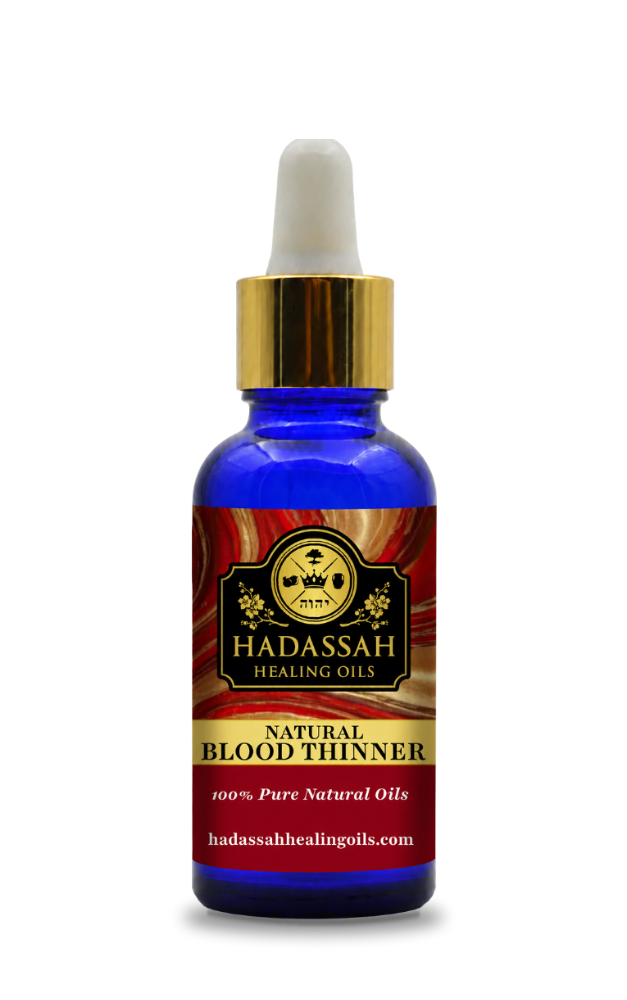
NATURAL BLOOD THINNER BLEND 30ML
R450.00 Incl. VAT
NATURAL BLOOD THINNER BLEND 30ML
Natural Blood Thinner Blend aids in naturally thinning the blood.
In stock
- 100% Natural
- 100% Pure Essential Oils
- 100% Manufacturing Guarantee
- Share to social media
Description
Directions for Use
Warning
Ingredients
Technical Information
NATURAL BLOOD THINNER BLEND 30ML
Hadassah Healing Oils Natural Blood Thinner Blend is a concentrated botanical formulation combining twelve plant-derived ingredients selected for their distinctive chemical constituents and relevance to research involving cardiovascular physiology, platelet function, inflammation and oxidative stress.
These botanicals contain a variety of aromatic and lipid-soluble compounds, including monoterpenes, phenolic compounds, sesquiterpenes and fatty acids.
Several of these chemical families have been investigated for effects on platelet activation, inflammatory pathways, oxidative stress and vascular biology.
The formulation is intended as an oral botanical product. However, the biological effects of individual plant compounds do not establish that the finished combination safely reduces clot formation or functions as a clinically effective blood thinner.
NATURAL BLOOD THINNER BLEND 30ML
Drink 1 capsule, of the Natural Blood Thinner, daily, after a meal.
If unable to us it internally, apply 10-15 drops over the neck, navel, and heart, daily.
IMPORTANT TO KNOW
All our blends come in a 30ml glass bottle, with a glass pipette and a rubber bulb on top. Don’t forget to buy empty veggie capsules when purchasing an ingestible blend. (Our veggie capsules are now available in 90’s and 150’s).
Never pre-fill capsules for future use, as this will compromise the veggie capsule and melt. Instead, always fill the capsules just before drinking them. (But if there is no other option, only prepare up to 3 days’ supply. You MUST then keep them upright in the refrigerator in a marked container; to know which blend it is filled with.)
Method – open the veggie capsule, then open your blend, squeeze, and release the rubber bulb to draw the oil blend up into the glass pipette dropper. Gently squeeze the rubber bulb to fill the larger part of the open capsule. Close the capsule before drinking it. Dosage is always a full capsule of a specific blend (between 15 to 18 drops) unless otherwise indicated.
If you need to take more than one oil blend per day, spread them throughout the day to assist the body with proper absorption. Never drink more than two capsules of different blends at a time.
It is always good to have a very small snack/fruit before drinking capsules.
Refer to the demonstration link below (Oil in Capsules)
NATURAL BLOOD THINNER BLEND 30ML
Healthy circulation depends on the interaction of blood vessels, the heart, blood cells and the body’s clotting-regulation systems.
Important aspects of cardiovascular health include:
- Regular physical activity
- Avoiding prolonged immobility
- Not smoking
- Managing blood pressure
- Managing diabetes and cholesterol when present
- Maintaining appropriate hydration
- Identifying inherited or acquired clotting disorders
- Following medical advice after surgery, during pregnancy and in other high-risk situations.
- Do not use it during the first trimester of pregnancy.
- People with a previous blood clot, atrial fibrillation, certain heart conditions or a diagnosed clotting disorder may require prescribed anticoagulant or antiplatelet medication. Botanical preparations should not replace these treatments.
- Protect from sunlight.
- Store below 25°c.
Not suitable for use in a diffuser, as it contains a carrier oil. Only undiluted pure essential oils may be used in a diffuser.
NATURAL BLOOD THINNER BLEND 30ML
Thyme,
Ginger
Spearmint
Peppermint
Frankincense
Myrrh
Rose Geranium
Oregano
Turmeric
Cinnamon
Cassia
Olive Oil
NATURAL BLOOD THINNER BLEND 30ML
Hadassah Healing Oils Natural Blood Thinner Blend is a concentrated botanical formulation combining twelve plant-derived ingredients selected for their distinctive chemical constituents and relevance to research involving cardiovascular physiology, platelet function, inflammation and oxidative stress.
Ingredients: Thyme, Ginger, Spearmint, Peppermint, Frankincense, Myrrh, Rose Geranium, Oregano, Turmeric, Cinnamon, Cassia and Olive Oil.
These botanicals contain a variety of aromatic and lipid-soluble compounds, including monoterpenes, phenolic compounds, sesquiterpenes and fatty acids.
Several of these chemical families have been investigated for effects on platelet activation, inflammatory pathways, oxidative stress and vascular biology.
The formulation is intended as an oral botanical product. However, the biological effects of individual plant compounds do not establish that the finished combination safely reduces clot formation or functions as a clinically effective blood thinner.
UNDERSTANDING THICK BLOOD AND BLOOD CLOTS
WHAT DOES “THICK BLOOD” ACTUALLY MEAN?
The expression thick blood is commonly used to describe several different medical conditions.
These conditions are related to blood circulation but are not interchangeable.
1. INCREASED BLOOD VISCOSITY
Blood viscosity describes how resistant blood is to flowing.
Blood can become more viscous when there is an increased concentration of red blood cells or certain blood proteins.
Conditions associated with increased viscosity include:
- Dehydration, which can temporarily concentrate blood
- Polycythaemia vera, a disorder involving excessive blood-cell production
- Certain other causes of elevated red blood-cell counts
- Some disorders involving unusually high concentrations of blood proteins
2. HYPERCOAGULABILITY
Hypercoagulability means that the blood has an increased tendency to form clots.
A person may have normal blood viscosity but still have a significant clotting risk.
Hypercoagulability can be inherited or acquired.
3. ABNORMAL PLATELET ACTIVATION
Platelets are small circulating cell fragments that help stop bleeding after injury.
When platelets become activated, they change shape, adhere to surfaces and release chemical signals that attract additional platelets.
Excessive platelet activation can contribute to certain types of thrombosis, particularly in damaged arteries.
4. SLOW OR DISTURBED BLOOD FLOW
Blood normally moves continuously through the circulation.
When flow becomes unusually slow, particularly in deep veins, clotting risk can increase.
This is why prolonged immobility, major surgery and certain medical conditions are important risk factors.
HOW BLOOD CLOTS FORM
Blood clotting is a normal protective process.
When a blood vessel is injured, the body activates several coordinated mechanisms to prevent excessive bleeding.
STEP 1 — BLOOD VESSEL RESPONSE
The damaged vessel sends signals that help limit blood loss and initiate repair.
STEP 2 — PLATELET ACTIVATION
Platelets attach to the injured area and begin forming a temporary plug.
STEP 3 — COAGULATION CASCADE
A sequence of clotting proteins becomes activated.
One important enzyme, thrombin, converts fibrinogen into fibrin.
STEP 4 — FIBRIN FORMATION
Fibrin forms a mesh that stabilises the platelet plug and traps blood cells.
STEP 5 — CLOT REGULATION
Natural anticoagulant systems help prevent excessive clot formation.
The body also uses fibrinolytic processes to break down clots when appropriate.
Problems arise when clotting occurs unnecessarily, becomes excessive or develops in the wrong location.
ROOT CAUSES OF INCREASED CLOTTING RISK
Medical science describes three major mechanisms that contribute to thrombosis. Together, these are known as Virchow’s triad.
1. BLOOD FLOW STASIS
Blood flow becomes abnormally slow.
Examples include:
- Prolonged bed rest
- Long periods of immobility
- Recovery after major surgery
- Certain forms of paralysis
- Some heart conditions
2. DAMAGE OR DYSFUNCTION OF BLOOD VESSELS
The inner lining of blood vessels, called the endothelium, helps regulate circulation and clotting.
Vessel injury or dysfunction may occur in association with:
- Surgery or trauma
- Smoking
- Atherosclerosis
- Diabetes
- High blood pressure
- Certain inflammatory conditions
3. INCREASED COAGULATION TENDENCY
The balance between clot-promoting and clot-limiting mechanisms becomes altered.
Contributing factors include:
- Inherited clotting disorders
- Antiphospholipid syndrome
- Certain cancers
- Pregnancy and the postpartum period
- Estrogen-containing hormonal medicines
- Some infections and inflammatory illnesses
- Certain kidney disorders
Other factors, including obesity, age and previous blood clots, can increase overall risk.
A person may have more than one risk factor at the same time.
THE BOTANICAL INGREDIENTS AND THEIR MEDICINAL CHEMISTRY
1. THYME — Thymus vulgaris
Thyme essential oil contains a range of aromatic compounds.
Depending on chemotype, these may include:
- Thymol
- Carvacrol
- Linalool
- Gamma-terpinene
Molecular properties
Thymol and carvacrol are phenolic monoterpenes.
They have demonstrated antioxidant, antimicrobial and inflammation-related activity in experimental studies.
Some laboratory investigations of phenolic plant compounds have also examined interactions with platelet function.
Relevance to circulation
Inflammatory signalling and oxidative stress are involved in vascular biology.
Thyme is therefore relevant to botanical research in these areas, although Thyme essential oil has not been demonstrated to prevent blood clots in humans.
2. GINGER — Zingiber officinale
Ginger is one of the more extensively studied botanicals in relation to platelet function.
Important compounds in ginger preparations include:
- Gingerols
- Shogaols
- Zingerone
- Aromatic sesquiterpenes
Molecular properties
Certain gingerols and shogaols have been investigated for effects on arachidonic-acid metabolism, cyclooxygenase activity and thromboxane production.
Thromboxane A₂ is an important signalling molecule involved in platelet activation.
Some laboratory studies have demonstrated reduced platelet aggregation following exposure to ginger-derived compounds.
What human research shows
Clinical findings are mixed. Some studies report reduced platelet aggregation, while others show no meaningful effect.
A systematic review concluded that the evidence remains inconclusive.
An additional distinction is important: ginger essential oil is chemically different from many ginger extracts because steam distillation does not efficiently carry over the nonvolatile gingerols and shogaols studied in much of the platelet research.
Relevance to this formulation
Ginger contributes botanical compounds of interest in inflammation and platelet research, but its presence does not establish a predictable anticoagulant effect.
3. SPEARMINT — Mentha spicata
Spearmint essential oil commonly contains:
- Carvone
- Limonene
- Other monoterpenes
Molecular properties
Carvone is a monoterpene ketone investigated for various biological activities.
Spearmint preparations have also been studied for antioxidant properties.
Relevance to circulation
The direct clinical evidence that Spearmint essential oil reduces clot formation or improves blood flow is insufficient.
Its contribution to this blend is primarily its distinctive botanical chemistry.
4. PEPPERMINT — Mentha × piperita
Peppermint essential oil commonly contains:
- Menthol
- Menthone
- Menthyl acetate
Molecular properties
Menthol interacts with TRPM8 receptors, which are involved in sensing cooling sensations.
Peppermint preparations have also been investigated for effects on smooth muscle and other physiological processes.
Relevance to circulation
These properties do not demonstrate that Peppermint essential oil dilates blood vessels sufficiently to prevent clots or functions as an anticoagulant.
5. FRANKINCENSE — Boswellia species
Frankincense essential oil contains aromatic terpenes, with composition depending on the species.
Possible constituents include:
- Alpha-pinene
- Limonene
- Sabinene
- Other monoterpenes and sesquiterpenes
Molecular properties
Frankincense-derived preparations have been studied for inflammation-related biological activity.
Boswellic acids, found in certain resin extracts, are different from the volatile compounds in steam-distilled essential oil.
Relevance to circulation
Frankincense is of interest in botanical inflammation research, but the essential oil has not been clinically established as a blood thinner.
6. MYRRH — Commiphora myrrha
Myrrh essential oil contains sesquiterpenes and furanosesquiterpenes, including:
- Curzerene
- Furanoeudesma-1,3-diene
- Lindestrene
Molecular properties
Myrrh-derived compounds have been investigated for antioxidant, antimicrobial and inflammation-related effects.
Relevance to circulation
These findings do not establish that Myrrh essential oil inhibits coagulation or prevents thrombosis in humans.
7. ROSE GERANIUM — Pelargonium graveolens
Rose Geranium essential oil contains:
- Citronellol
- Geraniol
- Linalool
- Other aromatic constituents
Molecular properties
Geraniol and citronellol have demonstrated biological activity in experimental studies, including antioxidant and inflammation-related effects.
Relevance to circulation
There is insufficient clinical evidence that Rose Geranium essential oil regulates platelet aggregation, blood viscosity or clotting risk.
8. OREGANO — Origanum vulgare
Oregano essential oil may contain:
- Carvacrol
- Thymol
- Gamma-terpinene
- Para-cymene
Molecular properties
Carvacrol and thymol are phenolic compounds with substantial laboratory research relating to antimicrobial and inflammation-associated activity.
Some experimental studies have investigated effects of these compounds on cellular signalling and platelet-related pathways.
Relevance to circulation
The findings remain insufficient to establish that orally consumed Oregano essential oil prevents blood clots.
Concentrated Oregano essential oil can also irritate mucous membranes and the digestive tract.
9. TURMERIC — Curcuma longa
Turmeric contains several different groups of compounds.
The most widely researched include:
- Curcumin
- Demethoxycurcumin
- Bisdemethoxycurcumin
- Turmerones
Molecular properties
Curcumin has been investigated for effects on inflammatory signalling, oxidative stress and platelet activation.
Experimental research has explored pathways involving cyclooxygenase, thromboxane and other mediators.
Important chemical distinction
Curcumin is a nonvolatile polyphenol.
Turmeric essential oil generally contains volatile turmerones rather than meaningful quantities of curcumin.
Therefore, research on concentrated curcumin supplements cannot automatically be used to describe Turmeric essential oil.
Relevance to circulation
Turmeric-derived compounds remain scientifically interesting, but the finished blend has not been demonstrated to produce a predictable antiplatelet or anticoagulant effect.
10. CINNAMON — Cinnamomum species
The chemical profile of Cinnamon essential oil depends on its species and whether it is distilled from bark or leaves.
Potential constituents include:
- Cinnamaldehyde
- Eugenol
- Other aromatic compounds
Molecular properties
Cinnamaldehyde has been investigated for antioxidant and inflammation-related effects.
Certain experimental studies have also explored its interactions with platelet-associated signalling.
Relevance to circulation
These findings do not establish that Cinnamon essential oil safely prevents thrombosis.
Concentrated Cinnamon Bark essential oil can cause significant irritation.
11. CASSIA — Cinnamomum cassia
Cassia is closely related to other cinnamon species but has its own chemical profile.
Cassia bark essential oil is often rich in cinnamaldehyde.
Molecular properties
Cinnamaldehyde has demonstrated biological activity in laboratory models involving inflammation and cellular signalling.
Cassia bark also contains coumarin, although its concentration in a finished essential oil depends on the material and extraction process.
Relevance to circulation
Coumarin naturally present in cassia is not equivalent to prescription warfarin and should not be assumed to produce a therapeutic anticoagulant effect.
Cassia-derived preparations can pose liver-related safety concerns depending on their composition and exposure.
12. OLIVE OIL — Olea europaea
Olive Oil is rich in fatty acids, particularly:
- Oleic acid
- Linoleic acid
- Palmitic acid
Nutritional properties
Olive Oil is an established component of many heart-healthy dietary patterns.
Extra-virgin Olive Oil may contain phenolic compounds associated with antioxidant activity.
Role in the formulation
Olive Oil provides a lipid-based carrier for the aromatic ingredients.
It does not make concentrated essential oils equivalent to culinary herbs or establish the safety or efficacy of the finished oral formulation.
HOW THE INGREDIENTS RELATE TO ONE ANOTHER
The botanical ingredients can be grouped according to their principal areas of scientific interest.
PLATELET-RELATED RESEARCH
Ginger-derived compounds, Curcumin and certain Cinnamon-associated compounds have been investigated for effects on platelet activation and arachidonic-acid signalling.
However, these findings are largely preparation-specific and cannot be assumed to apply to essential oils or the finished blend.
INFLAMMATION-RELATED RESEARCH
Thyme, Oregano, Ginger, Turmeric, Frankincense, Myrrh and other ingredients contain compounds investigated in experimental inflammatory models.
Inflammation is relevant to vascular health, but reducing an inflammatory marker in a laboratory experiment is not equivalent to preventing a blood clot.
ANTIOXIDANT RESEARCH
Several ingredients contain compounds that demonstrate antioxidant activity under experimental conditions.
Oxidative stress is involved in vascular biology, but laboratory antioxidant activity does not establish a clinical cardiovascular benefit.
BOTANICAL FATTY ACIDS
Olive Oil contributes dietary fatty acids and provides the formulation’s carrier base.
DOES THE COMBINATION PRODUCE A STRONGER BLOOD-THINNING EFFECT?
Combining several biologically active ingredients creates a chemically complex preparation.
However, the presence of multiple compounds does not automatically demonstrate synergy.
Interactions may increase, decrease or unpredictably alter biological effects.
There is no established clinical evidence showing that this particular combination produces controlled anticoagulation, safely reduces platelet aggregation or prevents blood clots.
SUPPORTING HEALTHY BLOOD CIRCULATION
Healthy circulation depends on the interaction of blood vessels, the heart, blood cells and the body’s clotting-regulation systems.
Important aspects of cardiovascular health include:
- Regular physical activity
- Avoiding prolonged immobility
- Not smoking
- Managing blood pressure
- Managing diabetes and cholesterol when present
- Maintaining appropriate hydration
- Identifying inherited or acquired clotting disorders
- Following medical advice after surgery, during pregnancy and in other high-risk situations
People with a previous blood clot, atrial fibrillation, certain heart conditions or a diagnosed clotting disorder may require prescribed anticoagulant or antiplatelet medication.
Botanical preparations should not replace these treatments.


